
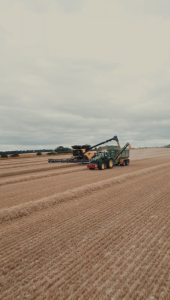
Harvest is one of the most important moments in the farming year at Birdsall. It is a season shaped by long days, changing weather and careful judgement, when months of work finally come together and the landscape begins to change almost by the hour. As the crops ripen across the Estate, there is a growing sense of anticipation; machinery is prepared, grain stores are checked and the forecast is watched closely. When conditions are right, the John Deere combine harvester moves into the fields and harvest begins in earnest. It is an intense period, but can be an incredibly satisfying one, bringing with it a real sense of purpose and teamwork.
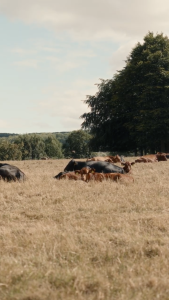
Birdsall is a mixed farm, which means that our cattle and arable enterprises work closely together. Rather than operating separately, each supports the other, creating a farming system that makes the best possible use of the land and the crops we grow. Our beef cows graze across some of the steeper parts of the Estate. Much of this land is difficult or unsuitable to plough, but it provides valuable grazing and allows the cattle to make use of areas that could not easily produce crops. During the winter months, the herd are fed largely on silage and barley grown here at Birdsall, while straw from the harvest is used for bedding. In turn, the manure produced by the cattle is returned to the arable areas of farmland. This helps to put valuable nutrients back into the soil and forms an important link between the livestock and arable sides of the farm. It is a simple cycle, but one that lies at the heart of mixed farming.
We have Stabiliser Beef Cattle at Birdsall, a mixed breed developed in Nebraska, USA by crossing Hereford, Angus, Simmental and Gelbvieh breeds to produce a cow that has been continually refined to leverage the best traits of each and produce the ultimate beef cow for conditions in the UK. We operate a closed herd of Stabilisers, rearing our own replacement females rather than regularly buying cattle in. This allows us to understand the history, temperament and performance of the herd over many generations. Our cows live outside all year around, in the fields in the summer months and in huge corrals over the winter months, creating much healthier animals. They calve in the spring, when the weather is becoming milder and grass growth is beginning to improve.
The young bulls are generally ready to leave the farm at around 14 to 16 months, while finished bulls and heifers are sold when they have reached the right stage. Most are taken by us to an abattoir in York. Transporting them ourselves means we can ensure they are handled calmly and carefully throughout the final part of their journey.
Across the arable land, we grow a varied selection of crops, including wheat, winter and spring barley, oilseed rape, vining peas and one-year grass leys for silage. The varied rotation helps to support soil health and allows us to respond to the different soil types found across the Estate. Much of our wheat is grown specifically for biscuit production. Not every variety of wheat is suitable for this, so the crops are chosen to meet the requirements of the end market. It is rather pleasing to think that wheat grown in the fields at Birdsall may eventually find its way into something as familiar as a packet of digestives!
Our winter barley is mainly kept on the farm and fed to the cattle, making it another important connection between harvest and the herd. The spring barley is grown for malting and making beer and must meet specific standards before it is accepted. If the grade of our harvested barley does not meet the standard needed for malting barley then the crop goes for animal feed but this means accepting a lower price per tonne.
We also grow oilseed rape, which is an extremely versatile crop. The oil it produces can be used in a wide range of products, including food, lubricants and fuel. Its bright yellow flowers are also one of the most recognisable sights in the spring landscape.
Our vining peas are grown under contract for Birds Eye. They are harvested while still young and sweet, before being frozen quickly to preserve their flavour and tenderness. The lorries that collect the peas from the field must be within 59 minutes’ travel time to the nearest processing plant, in our case this is in Hull, and the peas are processed within 1 hr 50 minutes from field to frozen. Seeing the Pea Viners working is one of the highlights of our harvest at Birdsall as these big machines swoop in, working 24/7, harvest the peas quickly and are gone onto the next farm within a day or two. Peas are a very useful part of the crop rotation because they naturally fix nitrogen in the soil, helping to improve fertility for the crops that follow.
Alongside these crops, we grow areas of clover and grass. These legume-rich crops require less man made nitrogen fertiliser and are made into silage for the cattle. They provide valuable winter feed while also helping us reduce the amount of artificial fertiliser needed on the farm.
Harvest itself is carried out using our John Deere Combine Harvesters. They are impressive pieces of machinery which allow us to cover a large areas when the weather window is right. Once the grain has been harvested, it is taken to our main drying and storage facility, where it can be carefully managed until it is ready either to leave the farm or be used as feed. We bring in a contractor to bale the straw left behind by the combines. Most of the straw remains at Birdsall, where the cattle will lie on it during the winter and eat a small amount of it as part of their diet. Only a limited quantity is sold, as it is such a valuable resource within the farm.
The soils across Birdsall vary considerably. In some places there is shallow clay over limestone, while other fields are lighter and sandier. Much of the Estate sits on chalk and traditional Yorkshire Wold soils, often with a high stone content. This means that each field needs to be managed slightly differently. Where possible, we try to avoid ploughing unnecessarily. The soil is only ploughed where there are particular grass weed problems that cannot be controlled in another way. Reducing cultivation can help protect soil structure, retain moisture and support the many organisms living beneath the surface.
Farming at Birdsall is not only about producing food. It is also about caring for the wider landscape and protecting it for the future. The Estate participates in a number of environmental stewardship schemes, including areas of wild bird cover, insect-friendly crops and land where no fertiliser is applied. Some of these areas sit alongside historic monuments and other important features of the Estate. Managing them sensitively allows farming, wildlife and heritage to exist alongside one another.
Harvest is therefore about far more than bringing in a crop. It is the result of careful decisions made throughout the year and marks the beginning of the next farming cycle. As the final fields are cleared and the straw is safely stacked, attention gradually turns towards autumn cultivations, winter feeding and preparations for the year ahead. There is always another job waiting on a farm, but harvest remains a moment to appreciate the land, the livestock and the people who work together to keep Birdsall moving forward.
 .
What kind of farm is Birdsall?
Birdsall is a mixed farm in the Yorkshire Wolds, roughly twenty miles east of York. Its Stabiliser beef cattle and arable crops work together as a single system, with the cattle grazing steeper ground and the manure returned to the arable land.
What breed of cattle does Birdsall keep?
Birdsall runs a closed herd of Stabiliser cattle, a breed developed in Nebraska from Hereford, Angus, Simmental and Gelbvieh bloodlines. The herd lives outside all year and calves in the spring.
What crops are grown at Birdsall?
The arable land grows wheat, winter and spring barley, oilseed rape, vining peas and grass leys for silage. Much of the wheat is grown for biscuit production and the vining peas are grown under contract for Birds Eye.
Where is the Birdsall Estate?
The Birdsall Estate sits in the Yorkshire Wolds, about twenty miles east of York, on chalk and traditional Wold soils with a high stone content.
